Weather Information

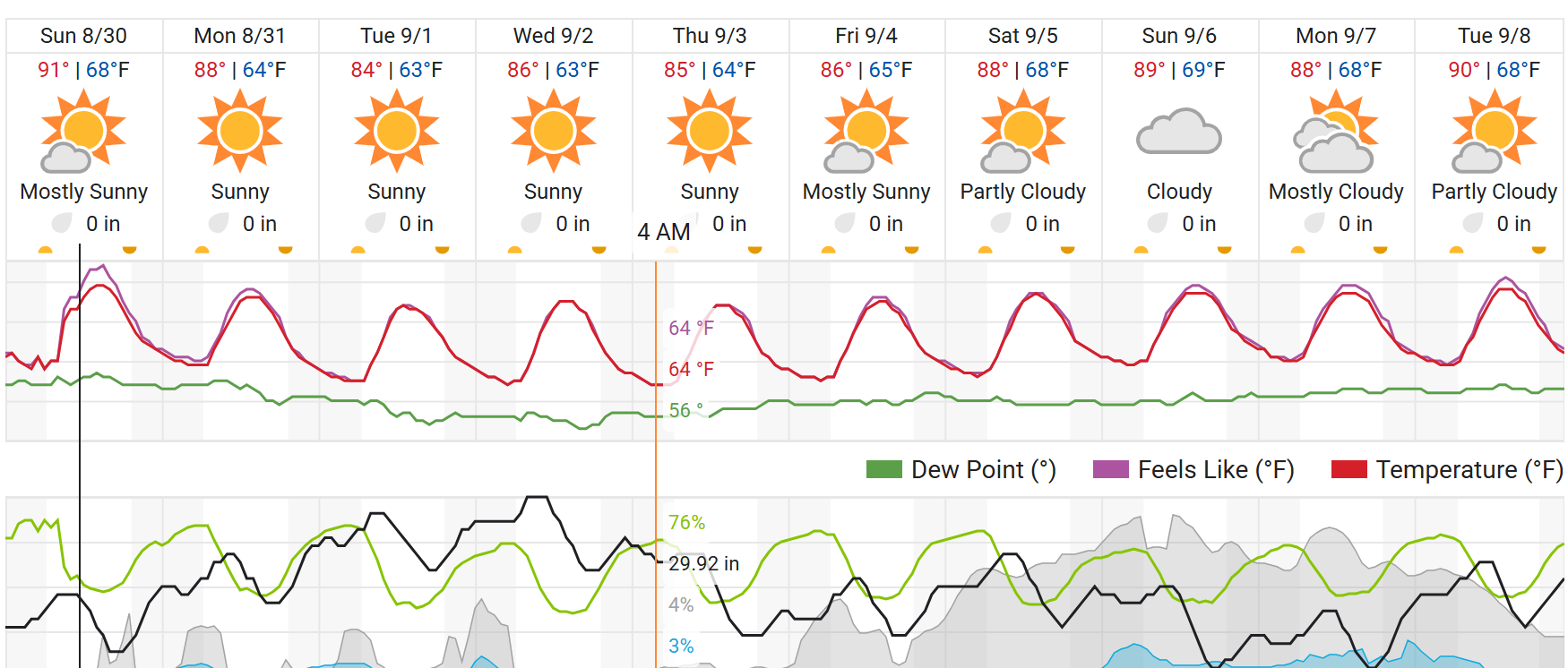
Weather forecasts help people plan their days and plan for particular meteorogical conditions. Here in Los Angeles one might not only plan for small temperature changes but also for unusual/inclimate situations, such as a rain storm in the middle of summer or unusualy warm days in fall. A popular website is Weather Underground .

    Core Elements of Weather:
  1. Temperature: A measure of heat energy in the air driven by uneven solar heating of the Earth.
  2. Air Pressure: The weight of the atmosphere. High-pressure systems bring clear skies, while low-pressure systems cause rising air, clouds, and storms.
  3. Wind: Air movement caused by pressure differences as warm air rises and cool air sinks.
  4. Humidity: The amount of moisture or water vapor in the air. Warm air holds more moisture than cold air. Precipitation: Condensed water vapor such as rain, snow, or sleet that falls when air cools to its dew point.

Weather is the state of the Earth's atmosphere at a specific place and time, typically described in terms of temperature, humidity, cloud cover, and stability.[1] On Earth, most weather phenomena occur in the lowest layer of the planet's atmosphere, the troposphere,[2][3] just below the stratosphere. Weather refers to day-to-day temperature, precipitation, and other atmospheric conditions, whereas climate is the term for the averaging of atmospheric conditions over longer periods of time.[4] When used without qualification, "weather" is generally understood to mean the weather of Earth. Weather is driven by air pressure, temperature, and moisture differences between one place and another. These differences can occur due to the Sun's angle at any particular spot, which varies with latitude. The strong temperature contrast between polar and tropical air gives rise to the largest scale atmospheric circulations: the Hadley cell, the Ferrel cell, the polar cell, and the jet stream. Weather systems in the middle latitudes, such as extratropical cyclones, are caused by instabilities of the jet streamflow. Because Earth's axis is tilted relative to its orbital plane (called the ecliptic), sunlight is incident at different angles at different times of the year. On Earth's surface, temperatures usually range ±40 °C (−40 °F to 104 °F) annually. Over thousands of years, changes in Earth's orbit can affect the amount and distribution of solar energy received by Earth, thus influencing long-term climate and global climate change.